Nursery & Bedding
How to Choose a Breathable Organic Blanket for a Baby’s Nursery
A nursery blanket can be soft, thoughtfully made, and useful in everyday family life. The important question is where and how it will be used. For an infant’s sleep, safety guidance comes before fiber choice; for supervised cuddles and other out-of-crib moments, texture, warmth, washability, and material are all worth considering.
There is a particular temptation, when preparing a nursery, to imagine the bed as a small landscape: a fitted sheet, a folded blanket, perhaps a quilt waiting at the foot. The real nursery is less composed. It is a place of changing temperatures, quick cleanups, repeated laundry, and a baby whose needs are not always announced in advance. A good blanket should meet that ordinary reality rather than merely complete a picture.
Choosing an organic baby blanket means weighing several things at once. The fabric should feel pleasant against delicate skin; its construction should suit the intended use; its warmth should be appropriate to the room and the baby’s clothing; and its care instructions should be manageable on a busy day. “Breathable” and “organic” can be useful clues, but neither word alone tells you whether a blanket is suitable for a particular setting.
One distinction matters most: a blanket intended for supervised use is not automatically suitable for a baby’s sleep space. Safe-sleep recommendations advise keeping loose blankets and other soft objects out of an infant’s sleep area. For sleep, follow current guidance from your child’s health-care professional and relevant public-health authorities, and use an appropriately fitted sheet on a firm, flat sleep surface. A nursery blanket may still have a place in the household—for supervised cuddles, a stroller outing when used safely, or as a layer for an adult—but it should not be treated as a substitute for safe sleep practice.
Start with the intended use
Before comparing cotton weaves or colors, decide what the blanket is for. “Nursery blanket” is a broad label, and products described that way can have very different sizes, weights, and constructions. A small blanket for supervised time on the floor has different practical demands from a larger layer kept on a nursing chair. Neither description, by itself, makes a blanket safe to place in a crib with a sleeping infant.
For supervised use, ask whether the blanket will be handled often, whether it needs to travel between rooms, and whether it will be washed frequently. A lightweight blanket may be easier to fold into a bag, while a plush surface may feel comforting during a quiet moment with a caregiver. If the blanket is for a stroller or car seat, consult the manufacturer’s safety instructions: loose fabric can interfere with straps or cover a baby’s face, so warmth should be managed without compromising the restraint system or airflow.
It can help to make a simple list before shopping:
- Where will the blanket be used, and will an adult be supervising?
- Does the intended setting call for a light layer or a warmer, more substantial feel?
- How often is the household realistically prepared to launder it?
- Does the product have clear material, sizing, and care information?
- Are there details—such as loose trims, ties, or decorative pieces—that make it less practical for the intended use?
These questions are less glamorous than choosing a nursery palette, but they tend to produce the more satisfying purchase. A blanket that suits a real routine is likely to be used; one chosen only for its appearance may spend most of its time folded on a shelf.
What “breathable” means in practice
Breathability is often discussed as if it were a single property, but a textile’s feel depends on more than its fiber. The yarn, weave, thickness, finishing, and amount of fabric all contribute. An open, airy construction may allow more air to circulate than a tightly packed, heavy one, but the blanket’s actual warmth still depends on its weight and how it is used. No fabric can guarantee that a baby will remain at a comfortable temperature in every room or circumstance.
Cotton is familiar for good reason: it has a soft hand, is available in many constructions, and is generally straightforward to wash according to the care label. Organic cotton describes how the cotton was grown and processed under the relevant certification standard; it does not automatically indicate that a blanket is lightweight, exceptionally breathable, or appropriate for an infant’s sleep space. Those questions require looking at the finished textile and the intended use.
Muslin is a plain-weave fabric often made with a relatively open structure. A blanket made from several layers of muslin can feel soft and airy while providing more substance than a single, very thin layer. The number of layers, yarn density, and finishing affect the result, so “muslin” is a starting point for comparison, not a complete description. If possible, read the product details and consider how the fabric feels in person.
Waffle and honeycomb weaves create a raised, textured surface. Their small pockets and ridges give the fabric a distinctive hand and can make a blanket feel more substantial without making it smooth or flat. Chenille, by contrast, is known for a plush, velvety surface; it can feel especially soft, though a plush texture may retain more warmth than a fine, airy weave. These differences are preferences as well as practical considerations. The right choice depends on the setting and the comfort of the person using it—not on an assumption that one weave is universally best.
Muslin, chenille, and textured cotton
Organic cotton blankets tend to fall into a few familiar tactile categories. Muslin is often light and relaxed. Chenille is plush and inviting. Waffle or honeycomb cotton has a more pronounced texture, with a balance of surface detail and everyday usefulness. These labels describe different experiences, but they should not be mistaken for safety ratings or promises about temperature.
A layered organic-cotton muslin blanket, such as the Naturepedic Organic Cotton Muslin Blanket described in the bedding range, illustrates the appeal of a soft, airy construction. Its four layers of organic cotton and crinkled finish provide a different feel from a smooth percale sheet or a thick chenille blanket. Product information describes it as versatile for layering and notes that it becomes softer with washing. As with any textile, follow its care label and use it only in settings appropriate to the child’s age and current safety guidance.
Chenille can be a good fit for families who prefer a plush hand for supervised use. Organic cotton chenille blankets in the broader bedding range are described as lightweight and soft, with a washed, gently puckered surface. Some reverse to a soft white side. That reversible feature is a small practical pleasure: it offers a different visual finish without requiring another blanket. It does not, however, turn a blanket into a suitable loose item for an infant’s sleep area.
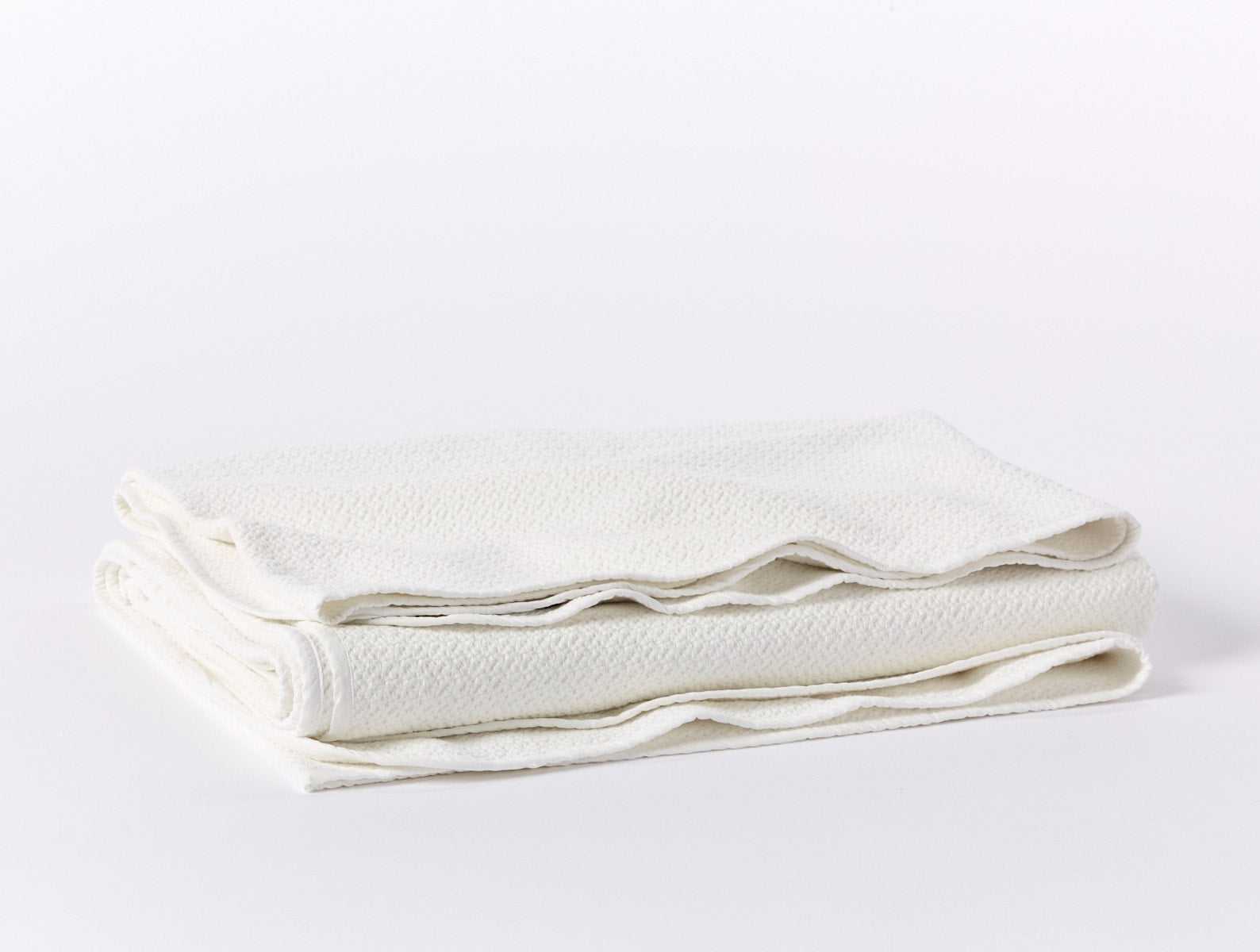
Textured cotton options offer another route. The Honeycomb Organic Blanket is made from 100% organic cotton, with a textured jacquard weave, color-matched percale trim, and a pre-shrunk finish. Its product details list GOTS, Fair Trade, and Made Safe certifications, along with machine washing on a cold, gentle cycle and tumble drying on low. This is a useful example of the information to compare when considering an organic cotton blanket for appropriate household or supervised use. Its listing does not describe it as a baby-specific blanket, so caregivers should not assume that it is designed for an infant or suitable for sleep.
Reading organic claims with care
The word “organic” can matter to families trying to understand the origin of fibers and the standards behind a product. But it is not a synonym for “chemical-free,” and it does not answer every question about the finished item. Dyeing, finishing, sewing, and packaging may each involve different processes. A trustworthy product description should identify the fiber content clearly and name any certifications precisely, rather than relying on a broad, reassuring adjective.
When a certification is listed, check what it covers. Some standards address the organic status of fibers or processing; others focus on social or environmental criteria, or on testing for substances in finished textiles. The name of a certification can be a helpful point of reference, but it is not a reason to skip the material label or care instructions. If a claim is important to your decision, consult the certifier’s own explanation of its standard.
Also distinguish a blanket’s fiber from its trim, thread, or filling. A product described as organic cotton may have additional components that should be identified separately. Clear specifications make it easier to understand what will touch the skin and how the item is constructed. When details are missing, asking the retailer for clarification is sensible; choosing another product with more complete information is sensible, too.
Warmth is a question of context
“Lightweight warmth” can sound contradictory until one considers how a blanket is used. A fine cotton layer may feel comfortable on a cool morning during supervised time with a caregiver, while the same layer may be unnecessary in a warm room. Room temperature, clothing, activity, and the time of day all affect comfort. A blanket’s fiber label cannot make those decisions for you.
Rather than buying the heaviest option for the sake of future use, think in layers and choose textiles that are easy to add or remove in appropriate settings. For infant sleep, do not add a loose blanket as a temperature solution; follow safe-sleep guidance and seek advice from a pediatric health professional if you are uncertain about clothing or room conditions. For supervised use, keep the baby’s face unobstructed and check that the blanket is not causing overheating.
A useful blanket is often the one that fits the season and the household’s habits. In a warm home, a breathable cotton fabric may be more practical than a thick plush one. In a cooler room, a denser texture may feel welcome when an adult is holding the baby. The same family may keep more than one type for different supervised settings, but there is no need to collect a drawerful before learning what actually gets used.
Size, finish, and everyday handling
Size influences convenience. A compact blanket is easier to fold and carry; a larger one offers more coverage for supervised floor time or for an adult’s lap. Check the listed dimensions rather than relying on words such as “baby,” “crib,” or “receiving,” which can be used differently across brands. A larger blanket is not automatically more useful, and it should never be placed loose in a baby’s sleep space simply because it is labeled for a nursery.
Edges deserve a quick inspection. Look for secure stitching and a finish that seems suited to regular laundering. Decorative fringe, long ties, buttons, and other small or loose elements may be charming on a chair throw, but they add complications around infants. Simpler designs are often easier to wash, fold, and pack. If the blanket develops loose threads or damaged seams, stop using it until it has been repaired or replaced.
Color is a matter of taste, though lighter shades can make stains easier to spot. Neutral tones often coordinate with a changing nursery, while a patterned or saturated color may be more forgiving between washes. In either case, the useful question is not whether the blanket photographs well but whether its finish survives the ordinary cycle of spills, laundry baskets, and hurried folding.
Washability is part of the design
New parents rarely need a textile that asks to be handled like an heirloom. Frequent washing can be part of the job, so a clear, manageable care label deserves attention before purchase. Some organic cotton blankets can be machine washed on a gentle cycle and tumble dried on low; others may require different temperatures, detergent, or drying methods. Follow the instructions for the specific blanket rather than assuming that all cotton behaves alike.
Pre-washed fabrics may feel softer from the outset and can be designed to reduce changes in shape, but washing can still affect texture over time. Use the recommended water temperature, avoid bleach unless the care label explicitly permits it, and remove the blanket promptly from the dryer when directed. If a blanket is intended to air-dry, allow enough time for it to dry completely before storing it.
It is also worth considering the household’s laundry rhythm. A delicate, dry-clean-only textile may be beautiful but poorly suited to a frequently used nursery. A machine-washable blanket may be easier to maintain, though repeated laundering can still wear fabric. A spare can be useful for supervised use during wash days; it is not necessary to buy multiple blankets for an infant’s sleep area.
A practical comparison checklist
When two blankets seem equally appealing, compare them on the details that will matter after the first wash and the first busy week:
- Fiber: Is the material composition stated clearly, including the trim or any filling?
- Construction: Is it muslin, chenille, waffle, honeycomb, or another weave—and does that texture suit the intended supervised use?
- Weight and dimensions: Do the product details provide enough information to judge how substantial and portable it is?
- Care: Can it be washed and dried in a way that works for your household?
- Finish: Are the edges secure, and are there embellishments that create unnecessary complications?
- Claims: Are organic or safety-related certifications named clearly enough to verify?
- Purpose: Does the description match how you intend to use it, without implying that it replaces safe-sleep guidance?
This checklist is deliberately plain. A blanket is not a complicated piece of equipment, but product language can make it seem as if every fabric carries a special promise. A clear description and a realistic sense of use are more valuable than a long list of adjectives.
Building a calmer nursery routine
Thoughtful nursery choices do not require a perfectly coordinated set. A fitted sheet, a few washable textiles for supervised moments, and a place to store them can be enough. Keep any blanket away from an infant’s sleep surface, and bring it out only when the setting and supervision make its use appropriate. Afterward, wash it as needed and store it dry, without leaving it draped where it could fall into a crib or other sleep space.
There is room for softness in a practical nursery. Organic cotton can be a reassuring material choice for families who value its growing and processing standards; muslin, chenille, and textured weaves offer different tactile experiences; and a manageable care label can make a real difference over time. The aim is not to find a blanket that claims to do everything. It is to choose a well-described textile that suits a particular task and to use it with the boundaries that infant safety requires.
In the end, the best organic baby blanket is not necessarily the plushest, palest, or most elaborately certified. It is the one whose materials and care instructions you understand, whose texture suits its supervised purpose, and whose place in the nursery is clear. That clarity—more than any decorative flourish—makes a small domestic object feel genuinely helpful.